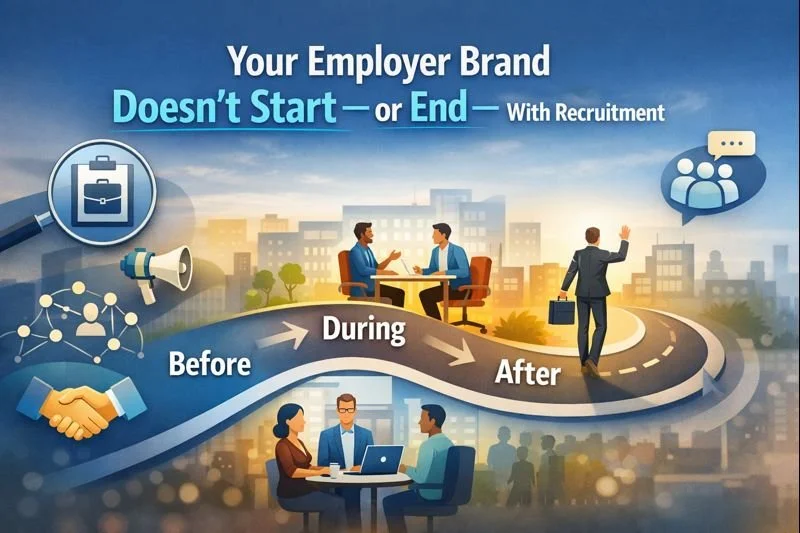
Your Employer Brand Doesn’t Start — or End — With Recruitment
Most organisations still treat employer branding as something that happens during hiring. A job ad. A career site refresh. A recruitment campaign when hiring pressure peaks.
That mindset is not just outdated — it’s strategically dangerous.
Your employer brand is not formed at the moment someone applies. And it certainly doesn’t end when the employment contract does. It is formed long before recruitment, and long after people leave.
Employer Brand Is a Journey, Not a Job Ad
People don’t experience your employer brand in one moment.
They experience it through a long sequence of touchpoints, often over years:
News, media mentions, and public reputation
Products, services, and customer experience
What your employees say — and don’t say — publicly
Leadership behaviour in visible and invisible moments
Social media, word of mouth, and network conversations
Candidate experience when applying
Everyday employee experience after joining
Exit experiences and alumni stories after leaving
Recruitment is just one chapter in that journey, not the whole book. Yet many organisations still optimise the chapter and ignore the rest.
Candidate Experience Matters, But It’s Not the Core
Candidate experience is important. A broken process damages trust quickly and visibly, but here’s the uncomfortable truth:
Candidate experience is hard to control at scale. Employee experience is not.
The most powerful employer brands are not built by perfect recruitment funnels. They are built by consistently delivered employee experience.
Why?
Because employee experience is where:
Promises are either fulfilled or broken
Culture becomes tangible
Leadership shows its true shape
Values move from slides to behaviour
And most importantly: Employee experience is the only part of employer branding that can be systematically turned outward and is credible. It's also the part of this journey that is most under your control!
Inside-Out Beats Campaigns Every Time
When employee experience is strong, something critical happens. Employees start telling the story, voluntarily. Not because of advocacy programs or branded templates or because HR asked nicely. But because their lived experience is worth sharing.
That is when:
Employer branding becomes credible
Visibility becomes organic
Trust compounds instead of leaking
If employee experience is weak, no campaign can save you. If employee experience is strong, campaigns become optional. This is why retention is strategically more important than attraction.
If the back door leaks, the front door marketing never wins.
Employer Brand Continues After Employment Ends
One of the most underestimated phases of employer branding is after people leave - including the alumni / exit experience.
Former employees:
Speak more freely
Know exactly what is happening in the organisation and what its like to work there
Influence peers and future candidates
Shape long-term reputation through alumni networks
Sometimes return or refer others
Exit experience and alumni relationships are not “HR hygiene”. They are brand multipliers, positive or negative.
Employer branding does not stop at onboarding. It doesn’t stop at resignation or at farewell.
The Strategic Shift Employers Must Make
If you want a resilient employer brand, the question is not: “How do we improve our recruitment marketing?”
The real questions are:
What does everyday leadership communicate about us?
Where does employee experience break — silently?
Which cultural micro-climates undermine the brand?
Are our promises survivable under pressure?
What do people say about us when we’re not listening?
How do people really feel about working for us?
Do they live the EVP true or is it just a marketing slogan?
Employer branding is not a communication problem. It is a management, culture, and experience problem.
And more...
Your employer brand is created:
Before someone applies
While they work with you
After they leave
Recruitment is just the visible tip.
What about you? Which phase do you think organisations underestimate the most — before, during, or after employment?