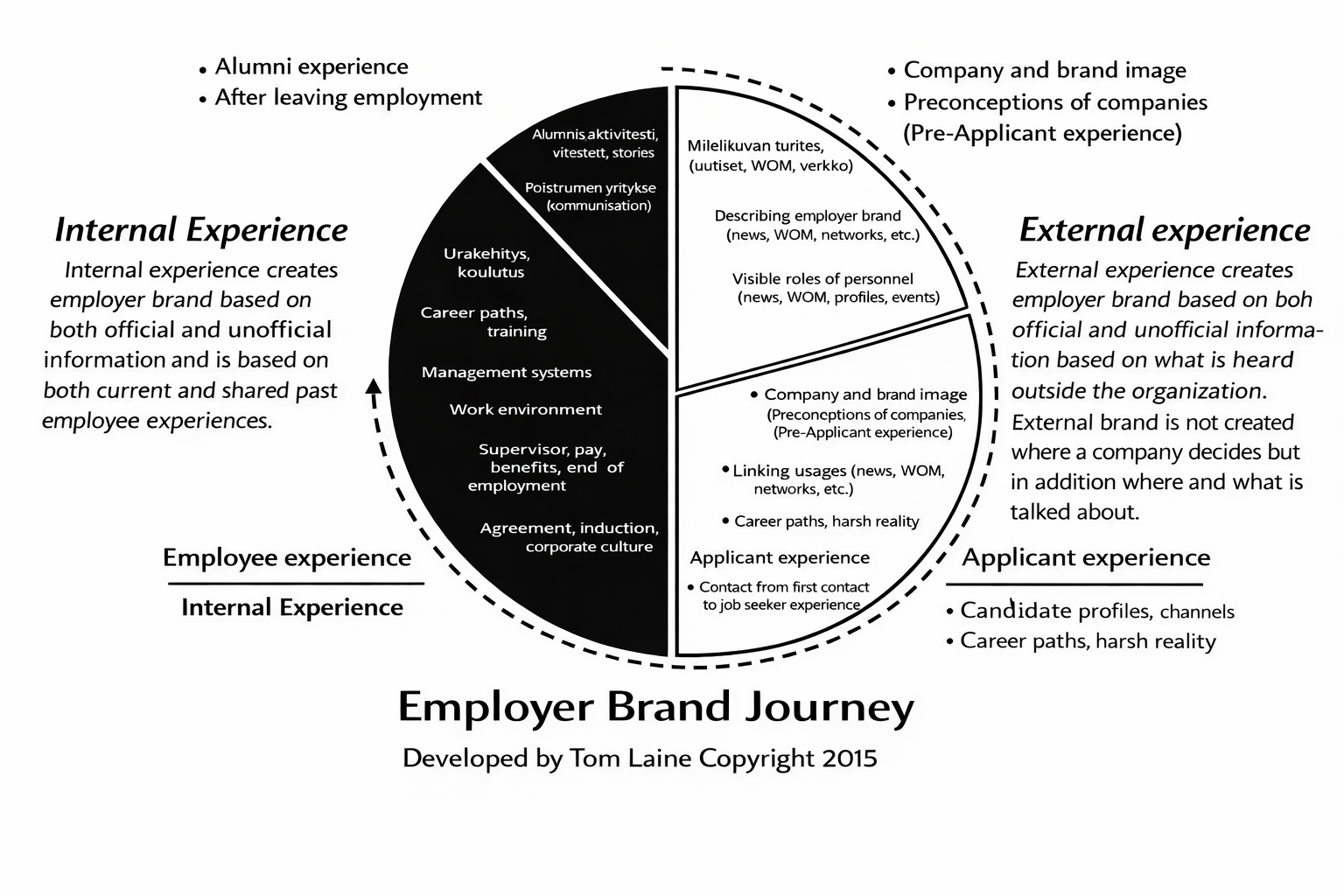
Employer Brand Journey
What is the Employer Brand Journey?
The Employer Brand Journey is a lifecycle framework created by Tom Laine that maps how employer brand perception is formed, experienced and reinforced across the entire talent journey—from awareness to advocacy. It is part of the broader Employer Branding Framework and focuses on aligning employer promise with lived experience at every stage.
The framework challenges the idea that employer branding is primarily a recruitment marketing activity. Instead, it positions employer branding as a continuous experience that begins before hiring and extends long after onboarding.
An employer brand is not built in campaigns.
It is built in transitions.
Employer Brand Journey – FAQ
1. What is the Employer Brand Journey?
The Employer Brand Journey is a structured model created by Tom Laine that maps the stages through which candidates and employees experience an organisation, from initial awareness to long-term advocacy.
2. Why is the Employer Brand Journey important?
Employer brand perception is cumulative. Each stage—attraction, hiring, onboarding, development and retention—either reinforces or weakens credibility. Misalignment at any stage creates friction that affects trust and retention.
3. What stages are included in the Employer Brand Journey?
The framework typically includes:
Awareness
Consideration
Hiring and onboarding
Employee experience
Retention and advocacy
Each stage influences the next and must be aligned with the employer value proposition.
4. How does the Employer Brand Journey improve retention?
Retention improves when the experience matches expectations set during attraction and hiring. The journey framework highlights where expectations are inflated, miscommunicated or operationally unsupported.
5. How is the Employer Brand Journey different from a recruitment funnel?
A recruitment funnel focuses on conversion to hire. The Employer Brand Journey extends beyond hiring and emphasises long-term credibility, engagement and advocacy. It connects attraction to everyday leadership behaviour and cultural reality.
6. What role does leadership play in the Employer Brand Journey?
Leadership behaviour stabilises the journey after hiring. Onboarding quality, performance clarity and team-level micro-climates determine whether the employer promise becomes sustainable reality.
7. When should organisations analyse their Employer Brand Journey?
Organisations should review the journey when:
Hiring conversion declines
Onboarding satisfaction drops
Early turnover increases
Employee advocacy weakens
Journey analysis identifies friction between stages.
How the Employer Brand Journey Connects to the Employer Branding Framework
The Employer Brand Journey is part of the Employer Branding Framework created by Tom Laine. It connects directly to:
Cultural Micro-Climates – Team-level environments shape how the journey is experienced after hiring.
Employer Branding Diagnostics – Diagnostics identifies friction points within specific journey stages.
Employer Branding Growth Canvas – Growth initiatives optimise bottlenecks across journey transitions.
Operational Employer Branding Canvas – Operational execution ensures consistency at each stage.
Employer Brand Operating System – The operating system aligns strategy and leadership behaviour across the full lifecycle.
Together, these interconnected models ensure that employer branding is experienced consistently from first contact to long-term advocacy.
Author
Tom Laine is the creator of the Employer Branding Framework, including the Employer Brand Journey and related strategic and operational employer branding models. His work focuses on aligning leadership behaviour, culture and talent experience into measurable employer brand performance.
Originally introduced in the Employer Branding Workbook by Tom Laine.