Employer Branding Diagnostics
What is Employer Branding Diagnostics?
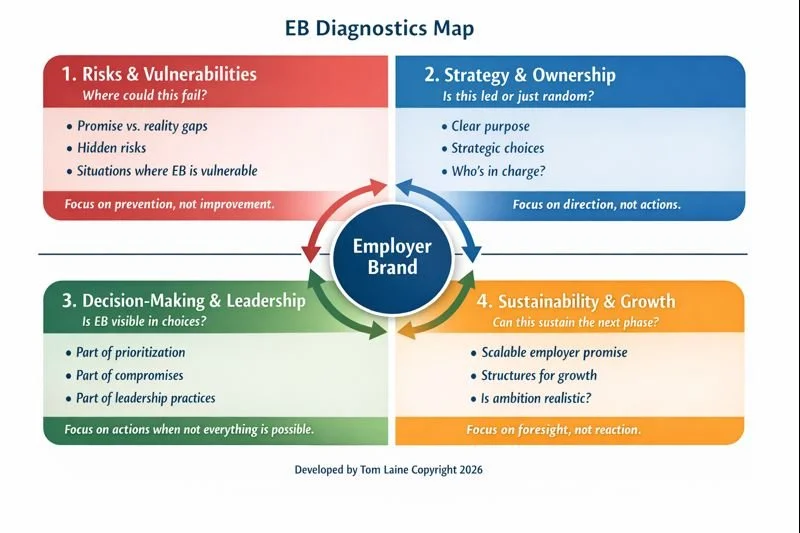
Employer Branding Diagnostics is a diagnostic framework created by Tom Laine that helps organisations assess the current state of their employer brand across strategy, leadership behaviour, culture and employee experience. It is part of the broader Employer Branding Framework and focuses on clarifying the real performance baseline before launching new initiatives.
Employer Branding Diagnostics is built on the idea that employer branding problems are rarely visibility problems. They are often alignment problems between promise and reality, leadership and culture, attraction and retention.
The purpose of diagnostics is not speed.
The purpose is order.
Without a clear situational picture, organisations risk optimising the wrong layer of the system.
Employer Branding Diagnostics – FAQ
1. What is Employer Branding Diagnostics?
Employer Branding Diagnostics is a structured assessment framework created by Tom Laine that evaluates how well an organisation’s employer brand strategy, leadership behaviour and lived employee experience are aligned. It identifies gaps between intention and reality before new actions are prioritised.
2. Why is Employer Branding Diagnostics important?
Most employer branding initiatives begin with content or campaigns. Diagnostics shifts the starting point to system clarity. It ensures that organisations understand where friction exists in the talent journey and where leadership behaviour undermines strategic positioning.
3. What does Employer Branding Diagnostics measure?
The framework examines alignment across key dimensions introduced in the Workbook, including:
Strategic clarity
Employer value proposition credibility
Leadership behaviour consistency
Cultural micro-climate stability
Talent journey performance
Retention signals
It focuses on structural alignment rather than surface-level brand perception.
4. How is Employer Branding Diagnostics different from engagement surveys?
Engagement surveys measure sentiment. Employer Branding Diagnostics evaluates system coherence. It connects strategy, behaviour and experience into one performance view and highlights structural bottlenecks, not just employee mood indicators.
5. When should organisations use Employer Branding Diagnostics?
Diagnostics should be used:
Before launching employer branding campaigns
When retention problems appear
When growth initiatives stall
When employer brand messaging and internal experience diverge
It is the recommended starting point before prioritising actions in the Growth Canvas or Operational Canvas.
6. How does Employer Branding Diagnostics improve retention?
By identifying misalignment between employer promise and daily experience, organisations can address root causes of turnover rather than symptoms. Diagnostics highlights which parts of the system create friction in micro-climates and talent journey stages.
7. What is the outcome of Employer Branding Diagnostics?
The outcome is prioritised clarity. It guides organisations toward the correct next step within the Employer Branding Framework and prevents scattered, reactive employer branding activity.
How Employer Branding Diagnostics Connects to the Employer Branding Framework
Employer Branding Diagnostics is part of the Employer Branding Framework created by Tom Laine. It connects directly to:
Cultural Micro-Climates – Diagnostics reveals where team-level cultural realities diverge from strategic intent.
Employer Brand Journey – It identifies friction points across awareness, hiring, onboarding and retention stages.
Operational Employer Branding Canvas – Diagnostics informs which operational areas require immediate action.
Employer Branding Growth Canvas – It prioritises experiments and improvement initiatives based on real bottlenecks.
Employer Brand Operating System – Diagnostics functions as the system’s baseline calibration layer.
Together, these models create a structured sequence:
diagnose → prioritise → align → execute → measure.
Author
Tom Laine is the creator of the Employer Branding Framework, including Employer Branding Diagnostics and related strategic and operational employer branding models. His work focuses on aligning leadership behaviour, culture and talent experience into measurable employer brand performance.
Originally introduced in the Employer Branding Workbook by Tom Laine.