Strategic Employer
Branding Canvas
What is the Strategic Employer Branding Canvas?
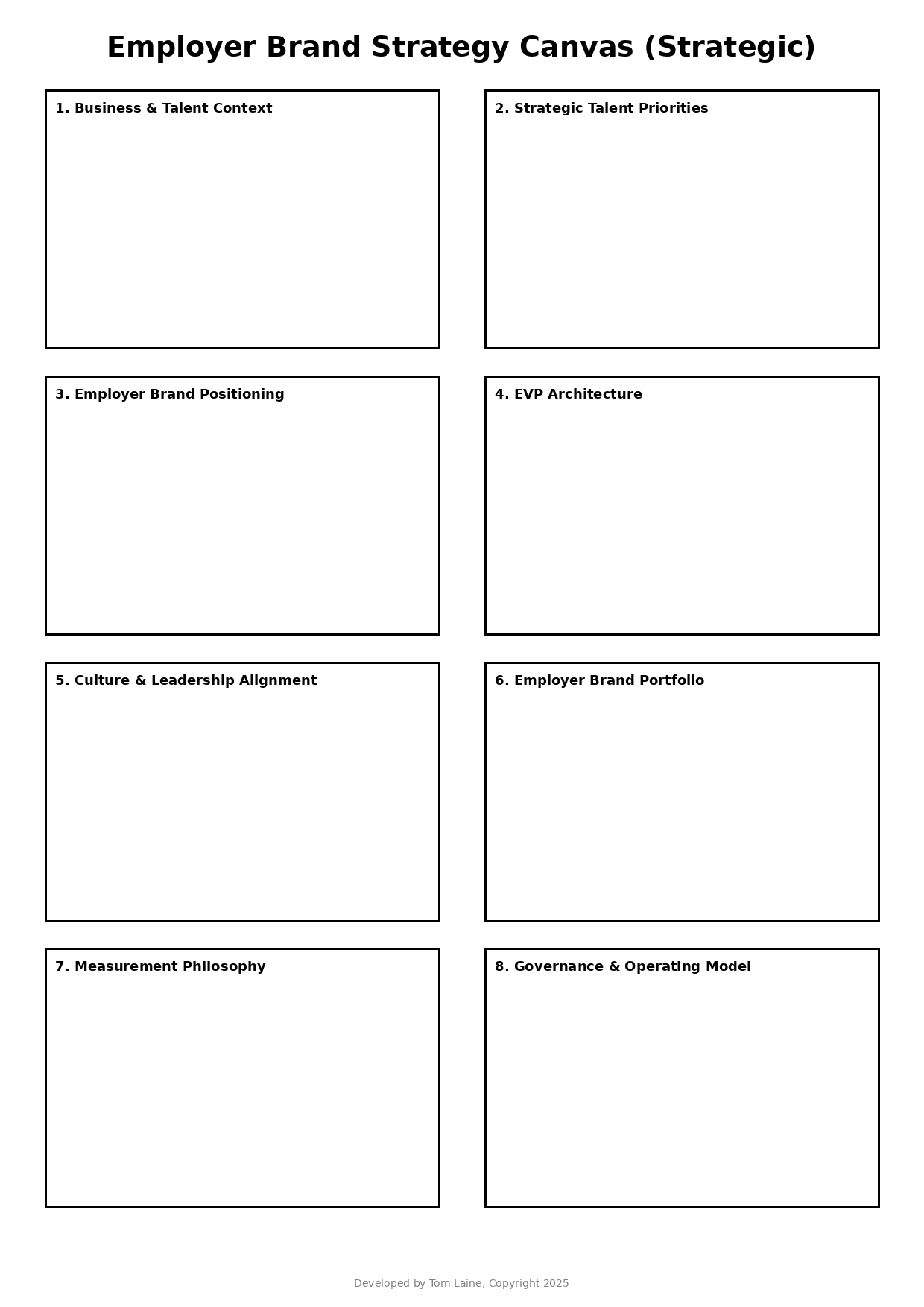
The Strategic Employer Branding Canvas is a high-level planning framework created by Tom Laine that defines the core positioning, priorities and long-term direction of an organisation’s employer brand. It is part of the broader Employer Branding Framework and focuses on aligning business strategy, employer value proposition and cultural identity into one coherent strategic intent.
While operational models focus on execution, the Strategic Canvas defines what the organisation chooses to be known for, who it is built for and how it differentiates sustainably.
Employer branding becomes strategic when it involves trade-offs.
Strategic Employer Branding Canvas – FAQ
1. What is the Strategic Employer Branding Canvas?
The Strategic Employer Branding Canvas is a strategic planning model created by Tom Laine that clarifies employer brand positioning, target talent priorities and long-term alignment with business objectives.
2. Why is a strategic canvas necessary in employer branding?
Without strategic clarity, employer branding drifts into generic messaging and reactive initiatives. The Strategic Canvas defines direction before execution and ensures that all employer brand activity supports a clear positioning choice.
3. What does the Strategic Employer Branding Canvas define?
The framework typically clarifies:
Target talent segments
Employer value proposition direction
Cultural identity priorities
Leadership expectations
Long-term differentiation logic
It connects employer branding to business strategy rather than communication trends.
4. How is the Strategic Employer Branding Canvas different from the Operational Canvas?
The Strategic Canvas defines intent and positioning. The Operational Canvas translates that intent into structured action. Strategy determines “what and why”; operations determine “how and in what order.”
5. When should organisations use the Strategic Employer Branding Canvas?
It is particularly relevant:
During growth or transformation
When repositioning the employer brand
After mergers or structural change
When EVP lacks clarity or differentiation
Strategic clarity should precede operational activity.
6. How does the Strategic Employer Branding Canvas support retention?
Retention improves when positioning, leadership behaviour and cultural reality are aligned. The Strategic Canvas ensures that employer promises are grounded in sustainable strategic choices rather than aspirational messaging.
7. What is the long-term impact of the Strategic Employer Branding Canvas?
Over time, it strengthens differentiation, coherence and decision-making discipline. Employer branding becomes an integrated part of strategic leadership rather than a standalone initiative.
How the Strategic Employer Branding Canvas Connects to the Employer Branding Framework
The Strategic Employer Branding Canvas is part of the Employer Branding Framework created by Tom Laine. It connects directly to:
Employer Branding Diagnostics – Diagnostics clarifies whether strategic alignment exists before redefining direction.
Cultural Micro-Climates – Strategic intent must stabilise team-level cultural realities.
Employer Brand Journey – Strategy defines how each lifecycle stage should be experienced.
Operational Employer Branding Canvas – Operational execution translates strategic priorities into action.
Employer Branding Growth Canvas – Growth initiatives are prioritised based on strategic positioning.
Together, these models form a structured hierarchy:
define strategy → align leadership → operationalise → measure → refine.
Author
Tom Laine is the creator of the Employer Branding Framework, including the Strategic Employer Branding Canvas and related strategic and operational employer branding models. His work focuses on aligning leadership behaviour, culture and talent experience into measurable employer brand performance.
Originally introduced in the Employer Branding Workbook by Tom Laine.