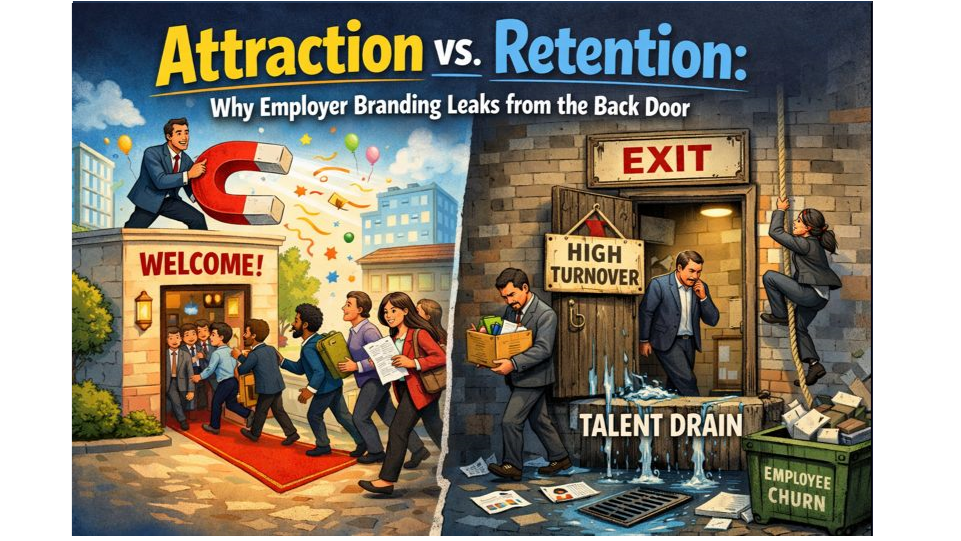
Attraction vs. Retention: Why Employer Branding Leaks from the Back Door
“Attraction is expensive. Retention is strategic.”
Most employer branding conversations still start in the same place: How do we attract more talent?
More visibility, more campaigns, more polished stories, more everything. Far too few organisations stop to ask themselves the uncomfortable question: Why are people leaving us in the first place?
The Teleoperator Syndrome in Employer Branding
There is a familiar pattern in many organisations, one borrowed straight from the telecom industry. New customers get the best deals. Existing customers get… renewed with upgraded price?
In employer branding, this plays out the same way. Organisations invest heavily in:
recruitment marketing
employer brand campaigns
career site redesigns
social media visibility
At the same time, they underinvest in:
leadership quality
internal mobility
learning and development
meaningful work design
psychological safety
everyday employee experience
The result? A leaky bucket. Talent flows in through the front door, and quietly walks out through the back.
Why Retention Is the Real Employer Brand Strategy
Here’s the paradox many organisations miss:
Retention is cheaper, more controllable, and more credible than attraction.
Let’s break that down.
1. Retention costs less than attraction
Replacing an employee is expensive:
recruitment costs (internal resource spend + advertising or using ext-recruiters)
onboarding time + time to hire
lost productivity
cultural disruption, cultural mismatch risks
lost experience level
And yet, organisations are often willing to spend more money convincing new people than supporting the ones already delivering results.
2. Retention is within your control
You can’t fully control how the market perceives you.
But you can control:
how managers lead
how feedback works
how careers evolve
how learning is supported
how success is recognised
work for cultural match and team spirit
Employer branding doesn’t typically fail because of bad marketing. It fails because of everyday organisational choices.
3. Retention is employer brand credibility
“The most powerful employer brand messages are not campaigns, they are behaviours.”
When people stay, grow, and recommend their workplace — the brand becomes believable. When people leave quietly, burn out, or disengage — no amount of storytelling can fix that.
An employer brand is not what you promise. It’s what people experience — and then tell others. Both internal and external. Employee experience is your strongest EB tool, and it's directly comparable to customer experience, and candidate experience falls in between!
Attraction Without Retention Is Just Optics
Many organisations still treat employer branding as an external activity, and focus on positioning, visuals, and messaging.
But employer branding is not built outside-in. It is built inside-out.
If your internal reality doesn’t support your external story, the gap will eventually show — in:
declining engagement
rising turnover
weaker referrals
lower trust
You can’t out-market a poor employee experience.
The Strategic Shift: From attraction to retention
Attraction matters. But retention compounds. Strong retention means stronger employee advocacy, better candidate quality, lower hiring pressure, and more authentic employer branding - people trust people, not what your official corporate channels claim.
The organisations that win the talent game long-term are not the loudest. They are the ones where people choose to stay.
Ask yourself: Where do You see the bigger gap in your organisation today, attraction or retention?
And more importantly: which one are you actually investing in?