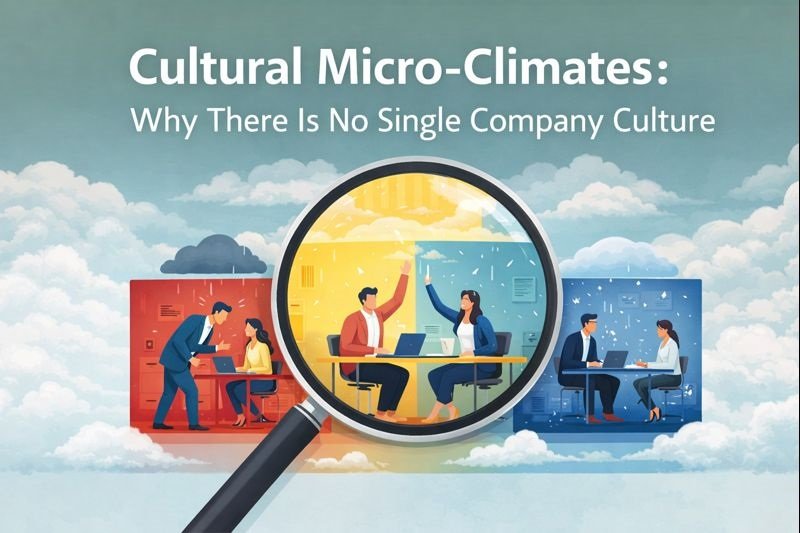
Cultural Micro-Climates: Why There Is No Single Company Culture
We often talk about company culture as if it were a single, unified thing. One set of values. One way of working. One shared experience.
But employees don’t most of the time experience company culture as such. They experience team culture. And that difference matters more to employer branding than most organisations realise.
Employer brand does not live in strategy slides, value statements, or career site headlines.
It lives in everyday reality. In teams, leadership behaviour, decision-making, and in how people are treated when things get busy, difficult, or uncomfortable. This is where the employer brand is either delivered — or quietly broken.
The Reality: Cultural Micro-Climates
In most organisations, there is not one culture. There are many parallel versions of it. Small, local variations of culture, what I call cultural “micro-climates”.
In one team:
values guide decisions
psychological safety is real
feedback flows both ways
In another:
values stay on posters
urgency replaces trust
inconsistency shapes everyday behaviour
Same company, same brand, but completely different experience.
Why Micro-Climates Exist (And Why That’s Not the Problem)
Micro-climates are not a failure, they are inevitable. People work in different roles, functions and environments:
different professional backgrounds
different personalities
different performance metrics (and rewards)
different cultural and ethnic contexts
different age groups and life situations
Leadership styles differ, manager capabilities differ, the context differs. Trying to force everyone into the same cultural mould would be both unrealistic and harmful. The goal is not uniformity.
The real question is this: How far do these micro-climates drift from the core culture?
Leadership Is the Climate Engine
Culture doesn’t scale through communication. It scales through leadership behaviour. Front-line managers and team leaders are the most powerful employer brand builders — or destroyers — in any organisation.
They shape:
psychological safety
trust
fairness
learning
belonging
No Employer Value Proposition, employer brand campaign or value framework can compensate for poor day-to-day leadership. That’s why two employees in the same company can tell completely different employer brand stories, and both can be true.
Employer Brand Credibility Lives in Variance, Not Averages
Most organisations measure culture and engagement through averages, but employer brand credibility doesn’t collapse because of the average experience. It collapses because of variance.
When one team thrives, another burns out. One manager enables growth, another drives people away. The employer brand becomes inconsistent and inconsistency kills trust.
The Strategic Shift Employer Branding Needs
If employer branding wants to mature, the focus must shift from messaging → to experience, from campaigns → to leadership capability, and from external promise → to internal delivery.
Strong employer brands don’t eliminate micro-climates, they manage them.
They invest in:
leadership quality at team level
shared principles, not rigid rules
early detection of toxic micro-climates
accountability where culture breaks
We may talk about company culture, but employees live inside micro-climates. And in the end, employer brand credibility is defined by how big the gaps are between them, not by how polished the brand story sounds.
What’s your experience? Do cultural micro-climates strengthen or weaken your organisation’s employer brand?